Showing posts with label commodities. Show all posts

Commodity Chart Of The Day: Crude Oil

10:19 |


 Disclosure: I have no positions in any stocks mentioned, and no plans to initiate any positions within the next 72 hours. I wrote this article myself, and it expresses my own opinions. I am not receiving compensation for it. I have no business relationship with any company whose stock is mentioned in this article.     
         
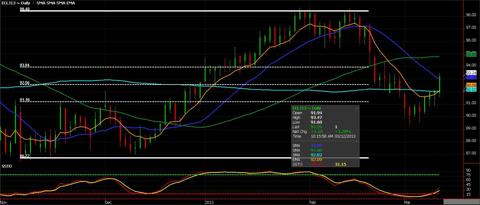
                                     Five out of the last 6 sessions, crude oil has traded higher. As of this post, April futures are $4 off their lows from last week. Prices are currently above their 18 day MA -- identified by the, To be continue CLICK FOLLOWING,,, http://seekingalpha.com/article/1266391-commodity-chart-of-the-day-crude-oil?source=yahoo 
Read More

Shenhua Energy Leads China Coal Stocks Lower as Equities Swing

23:05 |


Chinese stocks swung between gains and losses as declines by energy companies overshadowed gains by industrial companies.
China Shenhua Energy Co. and China Coal Energy Co. led coal producers lower. China Cosco Holdings Co. (601919), the world’s largest operator of dry-bulk ships, advanced 1.8 percent as better-than- estimated export data raised speculation demand for marine transport will rise.... CONTINUE READ, CLICK http://www.bloomberg.com/news/2013-01-10/china-s-stock-futures-rise-before-trade-data-baoshan-may-gain.html?cmpid=yhoo
Read More

Noble to Lift Aspire Stake to Increase Mongolia Coal Shipments

22:59 |


Noble Group Ltd. (NOBL), Asia’s biggest listed commodity supplier, agreed to boost its stake inAspire Mining Ltd. (AKM) and to help fund the explorer’s railway in northern Mongolia as seeks to expand coal shipments from the nation.
The Hong Kong-based trader will pay A$2.8 million ($2.9 million), or 8 cents a share, to increase its holding to 15 percent from 10 percent, Perth-based Aspire said today in a statement. Noble will also pay 10 percent of pre-development costs for a railway that will link Aspire’s coal mine to the existing Trans-Mongolian rail line, Aspire said.... CONTINUE READ,CLICK http://www.bloomberg.com/news/2013-01-10/noble-to-lift-aspire-stake-to-increase-mongolia-coal-shipments.html?cmpid=yhoo
Read More

Asian Stocks Advance on China Trade as Yen Weakens; Crude Gains

22:42 | ,


Asian stocks rose to a 17-month high after China’s exports grew more than estimated and investors speculated Japan will expand stimulus. Commodities advanced, while the yen neared a 2 ½-year low against the dollar.
The MSCI Asia Pacific Index (MXAP) climbed 0.8 percent at 2:39 p.m. in Tokyo. Futures on the Standard & Poor’s 500 Index added 0.3 percent. The Nikkei 225 Stock Average gained 0.8 percent as the yen weakened against all its major peers. The euro retreated 0.2 percent versus the greenback before the European Central Bank meets to review borrowing costs today. Crude advanced 0.4 percent in New York and aluminum rose for a fourth day. Yuan forwards strengthened the most in a year.
Pedestrians walk past the Bank of Japan headquarters in Tokyo, Japan. Photographer: Akio Kon/Bloomberg
China’s overseas sales rose 14.1 percent in December from a year earlier, almost triple the 5 percent gain predicted in a Bloomberg analyst survey, data showed today. Bank of JapanGovernor Masaaki Shirakawa said yesterday the central bank was in close cooperation with the government, spurring speculation policy makers will boost asset purchases when they meet Jan. 21-22. The ECB will probably keep its main refinancing rate at a record-low 0.75 percent, according to a Bloomberg survey.
“The Chinese data is a whole lot better than anyone expected,” said Mike Jones, a currency strategist at Bank of New Zealand in Wellington. “That will only add to recent investor optimism that the Chinese rebound has got legs.”
More than two stocks rose for each that fell on MSCI’s Asian gauge, with technology and financial companies leading the advance. Hong Kong’s Hang Seng Index (HSI) climbed 0.9 percent to its highest level since June 2011, while the Shanghai Composite Index added 0.5 percent. The Philippine Stock Exchange Index lost 1 percent, retreating from a record.

Mazda Upgrade

Aluminum Corp. of China Ltd. jumped 8.9 percent in Hong Kong, heading for its biggest advance since October 2011. Mazda Motor Corp. (7261) rallied 10 percent, leading gains among Japanese automakers, after Bank of America raised its rating on the stock to buy. Korea Electric Power Corp., which supplies all of South Korea’s electricity, rose 3.8 percent in Seoul trading after increasing power tariffs.
The S&P 500 advanced 0.3 percent yesterday. Fourth-quarter profit at companies in the index probably increased 2.9 percent, according to analyst estimates compiled by Bloomberg, extending a three-year expansion while marking the second-slowest quarterly growth since 2009.
The Japanese currency weakened 0.3 percent to 88.16 per dollar from yesterday, when it slid 0.9 percent, after Prime Minister Shinzo Abe urged the BOJ to double its inflation goal. The yen touched 88.41 on Jan. 4, the lowest level since July 2010. The yen declined 0.2 percent to 114.98 per euro, while the 17-nation shared currency lost 0.2 percent to $1.3041.

‘Economic Recovery’

“The Japanese government’s economic policy can prompt a sustained improvement in investor sentiment by weakening the yen before the recovery in the U.S. economy becomes definite,” said Naoki Kamiyama, an equity strategist at Bank of America Corp. in Tokyo. “It is a way to engineer an economic recovery.”
The Australian dollar climbed 0.4 percent to $1.0552 after touching $1.0555, its strongest since Dec. 18. Twelve-month yuan forwards strengthened 0.4 percent to 6.2763 per dollar in Hong Kong, the biggest gain since Jan. 18, 2012. The spot rate was 0.05 percent higher at 6.2228 in Shanghai, near a 19-year high of 6.2216 reached yesterday.
Chinese imports grew 6 percent after being unchanged in the previous month. The trade surplus almost doubled from a year earlier to $31.6 billion. The U.S. replaced the European Union last year as China’s largest export market, Zheng Yuesheng, head of customs statistics, said at a briefing today.

Treasuries Slide

Thirty-year Treasuries have almost wiped out 2012’s returns as investors prepared to bid at today’s $13 billion auction of the securities. U.S. 30-year bonds have handed investors a 2.3 percent loss in January as of yesterday, eroding last year’s 2.5 percent gain, according to Bank of America Merrill Lynch indexes. Thirty-year yields rose 0.2 basis points to 3.08 percent today.
Crude futures rose to $93.52 a barrel from $93.10 in New York. Copper for delivery in three months advanced 0.3 percent to $8,105.25 a metric ton in London, while aluminum added 0.7 percent to $2,090 a ton. Lead and zinc gained 0.7 percent.
Read More

Soft Commodity Quarterly Report: Cocoa, Coffee, Sugar Decline While Cotton Holds Steady Near Lows

00:27 |


by Edward Faubert
We examine performance of the major soft commodities during the fourth quarter of 2012.
Despite a year of more quantitative easing, soft commodity markets slump amid newfound surpluses.
Coffee
Coffee prices as measured by the ICE futures contract (KC) finished the fourth quarter at $1.438 a pound, down 38 cents, or 21 percent, on the quarter (down 78 cents or 35 percent for all of 2012). The market has been in an almost continuous slide since May 2011, when prices peaked at just over $3.00 a pound.
Read More

Oil down after dour Europe jobless report

22:09 |


BANGKOK (AP) -- The price of oil fell below $93 Wednesday after unemployment in the countries that use the euro rose to its highest level since the single currency was founded.
Benchmark oil for February delivery was down 19 cents to $92.96 per barrel at midday Bangkok time in electronic trading on the New York Mercantile Exchange. The contract fell 4 cents to 
Read More

Precision Castparts completes Titanium Metals deal

09:04 |

PORTLAND, Ore. (AP) -- Precision Castparts Corp. said Tuesday that it has completed its acquisition of Titanium Metals Corp. for roughly $2.9 billion.
The deal, first announced in November, gives Precision a titanium capability that it said has always been a key missing piece from its product portfolio.
To be continued,click the follwoing link
http://finance.yahoo.com/news/precision-castparts-completes-titanium-metals-163700560.html
Read More

Early Glance: Silver companies

07:40 |


NEW YORK (AP) -- Shares of some top silver companies are mixed at 10 a.m.:
Hecla Mining Co. fell $.08 or 1.4 percent, to $5.55.
Pan American Silver Corp. fell $.21 or 1.1 percent, to $18.22.
Silver Standard Resources Inc. rose $.22 or 1.5 percent, to $14.75.
Silver Wheaton fell $.29 or .8 percent, to $34.31.
Read More

U.S. natural gas futures slip early as milder weather arrives

07:05 |


NEW YORK, Jan 8 (Reuters) - U.S. natural gas futures lost
ground early on Tuesday, as mild near-term weather and record
high supplies pressured the complex for a second straight day.
    With government data on Monday showing gas production in
October hit a record high and inventories still at record highs
for this time of year, many traders expect prices to remain on

http://www.reuters.com/article/2013/01/08/markets-nymex-natgas-idUSL1E9C83HQ20130108?feedType=RSS&feedName=financialsSector&rpc=43
Read More

UPDATE 2-Iraqi Kurdistan starts independent crude oil exports

05:48 |


Tue Jan 8, 2013 7:01am EST

* First crude from Taq Taq oilfield reaches Turkish port

* Fresh tender for Kurdish condensate imminent

* KRG says crude trade through Turkey likely to continue

* KRG oil exports via Baghdad-controlled pipeline halted

By Julia Payne and Peg Mackey

LONDON, Jan 8 (Reuters) - Kurdistan has begun to export crude oil directly to world markets through Turkey, posing the biggest challenge yet to Baghdad's claim to full control over Iraqi oil.

The export of crude, in addition to small volumes of niche condensate, demonstrates the autonomous region's growing frustration with Baghdad as it moves towards ever greater economic independence, industry sources said.

Iraqi officials in Baghdad said the trade of Kurdish oil, which they view as illegal, would make it more difficult to reach a deal on payments to oil companies operating in the northern region, which the central government has delayed.

The volume of Kurdish oil involved is small, but industry sources said the direct export is highly symbolic as the Kurdistan Regional Government (KRG) seeks more financial autonomy.

The first crude has been delivered by truck to the Turkish port of Mersin on the Mediterranean.

"The KRG gave us permission to start crude exports from the Taq Taq oilfield," Genel Energy President Mehmet Sepil said in an interview on Monday.

But Baghdad insists that it has the sole right to export.

"If the Kurdistan Regional Government insists on moving in the wrong direction, even by bartering crude without legal approval, this will worsen the situation and make it more difficult to reach an agreement," a senior Iraqi oil official said.

Oil is at the heart of a deepening rift between Baghdad and Kurdistan that threatens to undermine the country's uneasy federal union just a year after the last American troops left.

The KRG halted exports through the Baghdad-controlled Iraq-Turkey pipeline last month due to the renewed payment dispute.

And a KRG source said the crude trade through Turkey was likely to keep going.

"Crude is a new component in the KRG's ongoing barter deal with Turkey, and it's likely to continue because Baghdad is not paying as agreed, nor is it supplying the KRG with sufficient refined products," the KRG source said.

"So the trade is part of our 17 percent entitlement to refined products, and the contractors will be able to earn their share as well, according to their contracts."

An agreement with Baghdad entitles Kurdistan to 17 percent of oil products refined in Iraq, the KRG source said.


NO OIL EXPORT BREAKTHROUGH

Oil shipments from Kurdistan are unlikely to resume through the federal pipeline system, with Kurdish and Iraqi Arab officials increasingly at odds over oil policy and autonomy, officials and sources said.

Kurdish and Iraqi officials said negotiations to resolve the dispute are at a stalemate and are now overshadowed by growing turmoil between Shi'ite Prime Minister Nuri al-Maliki and Sunni Muslim rivals, who say he has marginalised their community.

Thousands of protesters have taken to the streets in Sunni Muslim strongholds since December, when demonstrations erupted after security forces arrested bodyguards of Sunni Finance Minister Rafaie al-Esawi.

"No date has been set for a meeting between Kurdish regional officials and Iraqi oil officials to discuss payments and export issues. I think the current political crisis is preventing a date being set for a meeting," another Iraqi oil official said.

The KRG began exporting its own very light oil, or condensate, independently to world markets in October by truck to a Turkish port, where it was sold via an intermediary.

A fresh cargo of condensate is also ready to sell through an imminent tender, a shipping source said.

Industry sources reckon around 15,000 barrels per day (bpd)of condensate from the Khor Mor gas field are reaching the Toros terminal in Turkey. Just added crude oil exports from Taq Taq, for now, are also small.

In exchange, Turkey is sending back refined products to the Kurdish region, which is short of fuel.

Over the past year and a half, Kurdistan has upset Baghdad by signing deals with oil majors such as Exxon Mobil and Chevron, providing lucrative production-sharing contracts and better operating conditions than in Iraq's south.

The KRG says its right to grant contracts to foreign oil firms is enshrined in the Iraqi constitution, drawn up following the 2003 invasion that ousted Sunni dictator Saddam Hussein.

But payments to foreign operators in Kurdistan are caught up in the long-running spat over land and petroleum rights.

Baghdad said last month it would not pay oil firms operating in Kurdistan because the region had failed to export the volume of crude it pledged under a deal struck in September.

That agreement stipulated that Kurdistan would pump crude through the Baghdad-controlled Iraq-Turkey pipeline in return for payment. An export target of 200,000 bpd was set for the last two months of 2012, and Kurdish authorities pledged to raise exports to 250,000 bpd in 2013.

But exports of Kurdish oil have been halted since around mid-December, after nearing the 200,000 target early in the month.

Baghdad transferred an initial sum of 650 billion Iraqi dinars ($560 million) to the KRG. But a second payment is still pending for the foreign companies in Kurdistan.
Read More

Natural Gas Drops as Late January Weather Forecasts Turn Milder

10:25 |


Natural gas futures fell in New York, reversing an earlier gain, amid revised forecasts for milder weather in late January that would reduce demand and a government report showing record production.
Gas slid as much as 1.5 percent after MDA Weather Services said a midday weather update showed warmer weather for the Midwest and the East over the next 11 to 15 days. Output in the contiguous U.S. states climbed 0.4 percent to a record 73.54 billion cubic feet a day in October from the previous month, according to the Energy Department’s monthly EIA-914 report.
“The market is holding out hope that colder weather at the end of January will salvage the heating season,” said Teri Viswanath, director of commodities strategy at BNP Paribas SA in New York. “The problem is the 11- to 15-day forecast turned warmer. Less heating demand than originally expected will mean slightly higher end-of-season storage levels. The 914 data is just affirmation that supplies are continuing to grow.”
Natural gas for February delivery dropped 4 cents, or 1.2 percent, to $3.247 per million British thermal units at 1:01 p.m. on the New York Mercantile Exchange. Trading volume was 32 percent below the 100-day average. Gas prices have risen 5 percent from a year ago.
April $2.50 puts were the most active options in electronic trading on the Nymex. They fell 0.4 cent to 0.9 cent on volume of 1,873 lots at 12:51 p.m. Puts accounted for 73 percent of the volume so far today.
The price spread of February futures to April contracts, representing cold-weather versus warm-weather months, widened 0.2 cent to 5.2 cents, increasing for the first time in three days.
Read More

Crude Oil Drops From Highest in Three Months.

05:29 |

Crude slid for the first time in three days in New York on speculation that this week’s gains were unjustified as the U.S. budget deal is insufficient to ensure growth in the world’s biggest oil-consuming country.
Futures lost as much as 0.7 percent after rallying 2.6 percent in the past two sessions as U.S. lawmakers passed a bill to undo automatic tax increases and spending cuts that threatened the nation’s economic recovery. The accord won’t reduce deficits enough to avoid a sovereign-rating downgrade, Moody’s Investors Service said yesterday. Technical indicators showed crude may have risen too quickly, according to data compiled by Bloomberg.
“We’re seeing short-term jitters on the back of Moody’s comments of a potential downgrade in the pipeline if things are not improved in the coming months,” said Michael Poulsen, an analyst at Global Risk Management Ltd. in Middelfart, Denmark.
West Texas Intermediate for February delivery dropped as much as 63 cents to $92.49 a barrel in electronic trading on the New York Mercantile Exchange and was at $92.76 as of 1:05 p.m. London time. The contract yesterday climbed 1.4 percent to $93.12 a barrel, the highest settlement for a contract nearest to expiration since Sept. 18.
Brent for February settlement on the London-based ICE Futures Europe exchange fell as much as 84 cents to $111.63. Prices advanced 3.5 percent in 2012, a fourth annual gain. The North Sea crude was $19.37 a barrel more than WTI.
Trading volume in WTI was 26 percent below the 100-day average for the time of day, while Brent was 6 percent above.

Debt Ratio

The ratio of U.S. government debt to gross domestic product will likely peak at about 80 percent in 2014 and may stay at about that level for the rest of the decade, New York-based Moody’s said yesterday in a statement. The ratings company assigns the U.S. its top Aaa ranking and has a negative outlook on the grade.
“Further measures that bring about a downward debt trajectory over the medium term are likely to be needed,” Moody’s said.
WTI yesterday settled higher than the 30-day upper Bollinger Band for the fourth time in a week, signaling the market is overbought, according to data compiled by Bloomberg. Prices decreased in mid-September after closing above the same indicator, about $92.49 a barrel today.
The crude’s 14-day relative strength index for front-month prices rose to 68.1 yesterday, the highest level since Sept. 14. A reading above 70 is a signal to investors that price increases may have been excessive. It is at 64.9 today.
“We’re getting a mild sell signal and the coincidence of those levels mean that some traders will be bailing out,” said Michael McCarthy, a chief strategist at CMC Markets in Sydney. “What we’re seeing is longs closing out, taking some profit.”

Oil Inventories

U.S. crude stockpiles probably fell by 500,000 barrels to 370.6 million in the seven days ended Dec. 28, according to the median estimate of nine analysts surveyed by Bloomberg before an Energy Department report tomorrow. A drop of that size would leave supplies at the lowest level since the week to Oct. 12.
The Energy Department is scheduled to release its weekly report in Washington two days later than usual because of the New Year holiday. The industry-funded American Petroleum Institute will publish its inventory data later today.
Stockpiles at Cushing, Oklahoma, America’s largest storage hub and the delivery point for the New York contract, increased 2.21 million barrels to a record 49.2 million in the seven days ended Dec. 21, the Energy Department reported on Dec. 28.

Seaway Expansion

WTI slid 7.1 percent in 2012 as the U.S. shale boom deepened a supply glut at Cushing. That left it at an average $17.47 barrel below Brent last year, compared with a premium of about 95 cents in the 10 years through 2010.
“Final work is being performed” on the Seaway pipeline that was reversed in May to carry crude from Cushing to the Gulf Coast, owners Enterprise Products Partners LP (EPD) and Enbridge Inc. (ENB) said yesterday. Capacity is being expanded to 400,000 barrels a day from 150,000 and operations will start at full rates by the end of next week, according to a joint statement.
The U.S. House vote to pass legislation avoiding the so- called fiscal cliff capped a final push as Republicans balked at a bipartisan Senate bill. House Speaker John Boehner ordered a vote even as 151 of 236 Republicans, including Majority Leader Eric Cantor, ultimately voted no. President Barack Obama said he’d sign the bill into law.
Read More